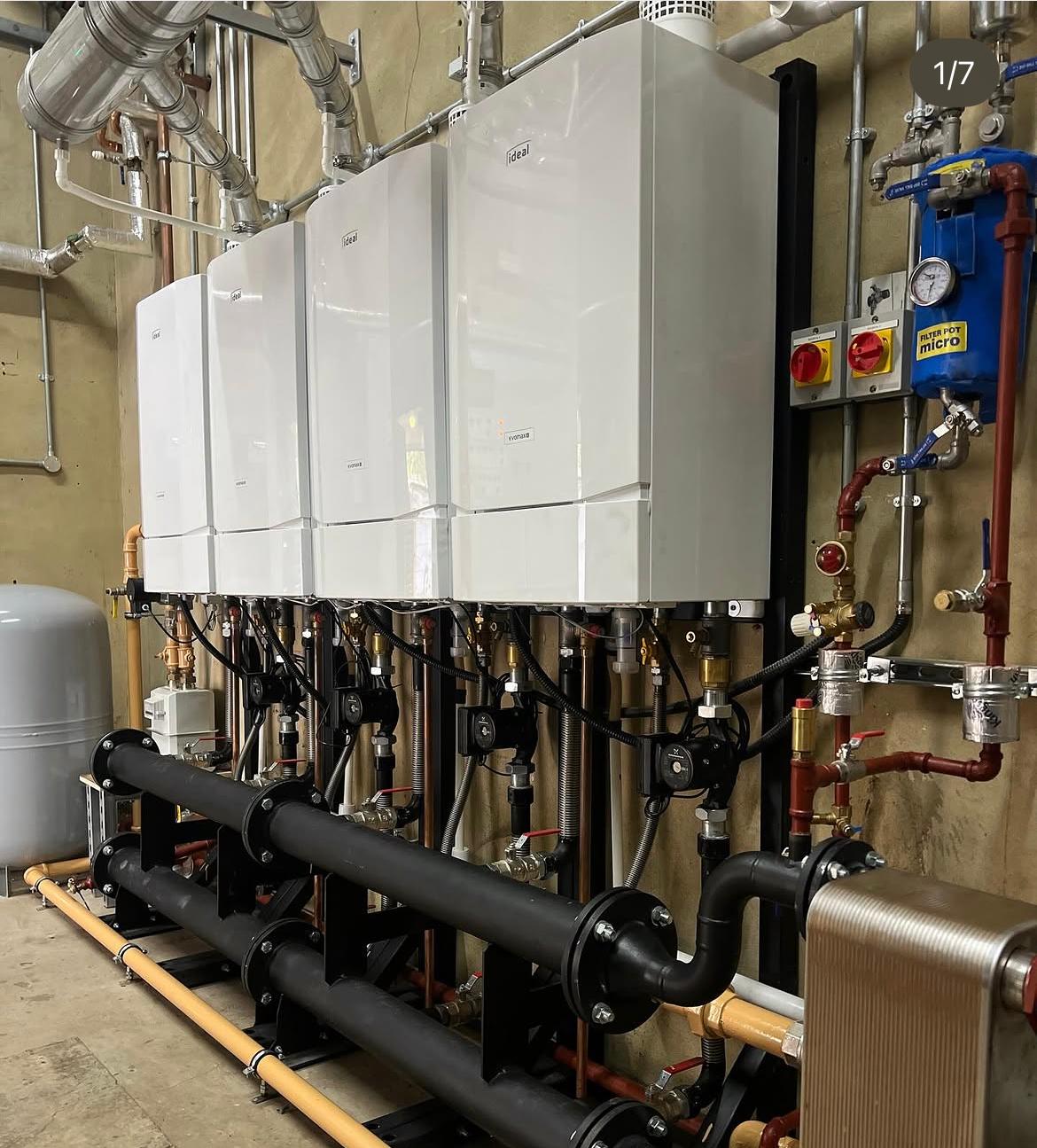
 Boilers
31 May 2026 · 5 min read
If you live in Hertfordshire, Essex, or the surrounding area, you live in one of the hardest water regions in the UK. Hard water — water with a high mineral content, primarily calcium and magnesium — is perfectly safe to drink, but over time it causes significant damage to your plumbing system, your boiler, and your household appliances. Understanding the problem is the first step to protecting your home.
Water hardness is measured in milligrams per litre (mg/L) or parts per million (ppm) of calcium carbonate. Water above 200 mg/L is considered hard; above 300 mg/L is very hard. Much of Hertfordshire and Essex sits in the 300–400 mg/L range. When hard water is heated — in your boiler, your kettle, or your shower — the dissolved minerals precipitate out and form limescale: that familiar white, chalky deposit you see on taps, showerheads, and inside kettles.
The heat exchanger in your boiler is the component most vulnerable to limescale damage. As water passes through the heat exchanger and is heated, limescale deposits build up on the internal surfaces. This has two serious consequences: first, it acts as an insulator, forcing the boiler to work harder and use more gas to achieve the same heat output; second, it can cause localised overheating — the 'kettling' sound you may have heard from an older boiler — which over time leads to cracking and failure of the heat exchanger. Replacing a heat exchanger is one of the most expensive boiler repairs, often costing £400–£600 or more.
Limescale doesn't just affect the boiler. Over years of use, it can build up inside copper pipework, gradually reducing the bore of the pipe and restricting flow. In severe cases, this can cause noisy pipes, reduced water pressure, and — in extreme instances — blocked pipes that need replacing. Your radiators can also be affected: sludge (a mixture of limescale, rust, and other deposits) accumulates at the bottom of radiators, creating cold spots and reducing efficiency.
Beyond the heating system, hard water shortens the lifespan of washing machines, dishwashers, and electric showers. The heating elements in these appliances are particularly susceptible to limescale build-up, which reduces efficiency and eventually causes failure. Showerheads and taps also suffer — the small orifices through which water flows can become partially or fully blocked with limescale, reducing flow and requiring regular cleaning or replacement.
Research suggests that in hard water areas, a 1.6mm layer of limescale on a boiler heat exchanger increases energy consumption by around 12%. Over a year, that's a meaningful addition to your gas bill.
There are several effective approaches to managing hard water in your home, and the right solution depends on your budget and the severity of the problem.
These devices are fitted to the incoming water supply and use magnets to alter the structure of the calcium carbonate crystals, making them less likely to adhere to surfaces. They're inexpensive as a product (typically £20–£100) and require no maintenance or salt, but the evidence for their effectiveness is mixed. Bear in mind that fitting still requires a qualified plumber — with our minimum call-out rate of £90+VAT, the total installed cost will reflect this. They can help reduce new scale formation but won't remove existing deposits.
Electrolytic or electronic scale inhibitors are more effective than magnetic conditioners and are a popular choice for protecting boilers and heating systems. They're fitted to the cold water supply and work by introducing small amounts of zinc or other minerals that inhibit scale formation. The device itself typically costs £100–£250, but fitting requires a qualified plumber. With our minimum labour rate of £90+VAT per hour, expect a total installed cost of around £200–£400 depending on the complexity of the installation.
A whole-house water softener is the most comprehensive solution. These devices use an ion exchange process to replace the calcium and magnesium ions in hard water with sodium ions, effectively eliminating hardness throughout the entire property. The benefits are significant: no limescale anywhere in the house, softer skin and hair, longer appliance lifespans, and reduced detergent usage. The downside is cost — a quality water softener installed typically costs £1,000–£1,500 including VAT — and the ongoing need to top up with salt. However, for homes in very hard water areas, the long-term savings on appliance replacement and energy bills can make it a worthwhile investment.
If your heating system already has sludge and scale build-up, a power flush — a process that forces clean water and cleaning chemicals through the system at high velocity — can remove existing deposits and restore efficiency. After a flush, adding a quality inhibitor chemical to the system helps prevent future build-up. This is something we recommend as part of any boiler installation or replacement.
Prime Degrees Ltd
Gas Safe Registered Engineers · Hertfordshire & Essex
Our Service
Protect your plumbing from hard water damage. Our engineers can assess your system, carry out a power flush, and advise on the best water treatment solution for your home.
Boilers31 May 2026 · 5 min read
 Renewables
 Bathrooms
Get honest, no-obligation advice from our Gas Safe registered engineers.