 Boilers
31 May 2026 · 5 min read
Heat pumps have gone from a niche technology to a mainstream heating option in the space of just a few years. With the UK government pushing hard to phase out gas boilers in new builds and offering substantial grants to encourage the switch, more and more homeowners are asking the same question: is a heat pump right for my home?
The honest answer is: it depends. Heat pumps are genuinely excellent technology — efficient, low-carbon, and increasingly cost-effective — but they're not a like-for-like swap for a gas boiler. Understanding how they work, what they need to perform well, and what the installation involves will help you make the right decision for your home. This guide covers everything.
A heat pump doesn't generate heat in the traditional sense — it moves heat from one place to another. An air source heat pump (the most common type) extracts thermal energy from the outside air — even when it's as cold as -15°C — and transfers it into your home via a refrigerant cycle, similar in principle to how a fridge works in reverse. For every unit of electricity it consumes, a modern heat pump can deliver two to four units of heat. This ratio is called the Coefficient of Performance (COP), and it's why heat pumps are so much more efficient than direct electric heating.
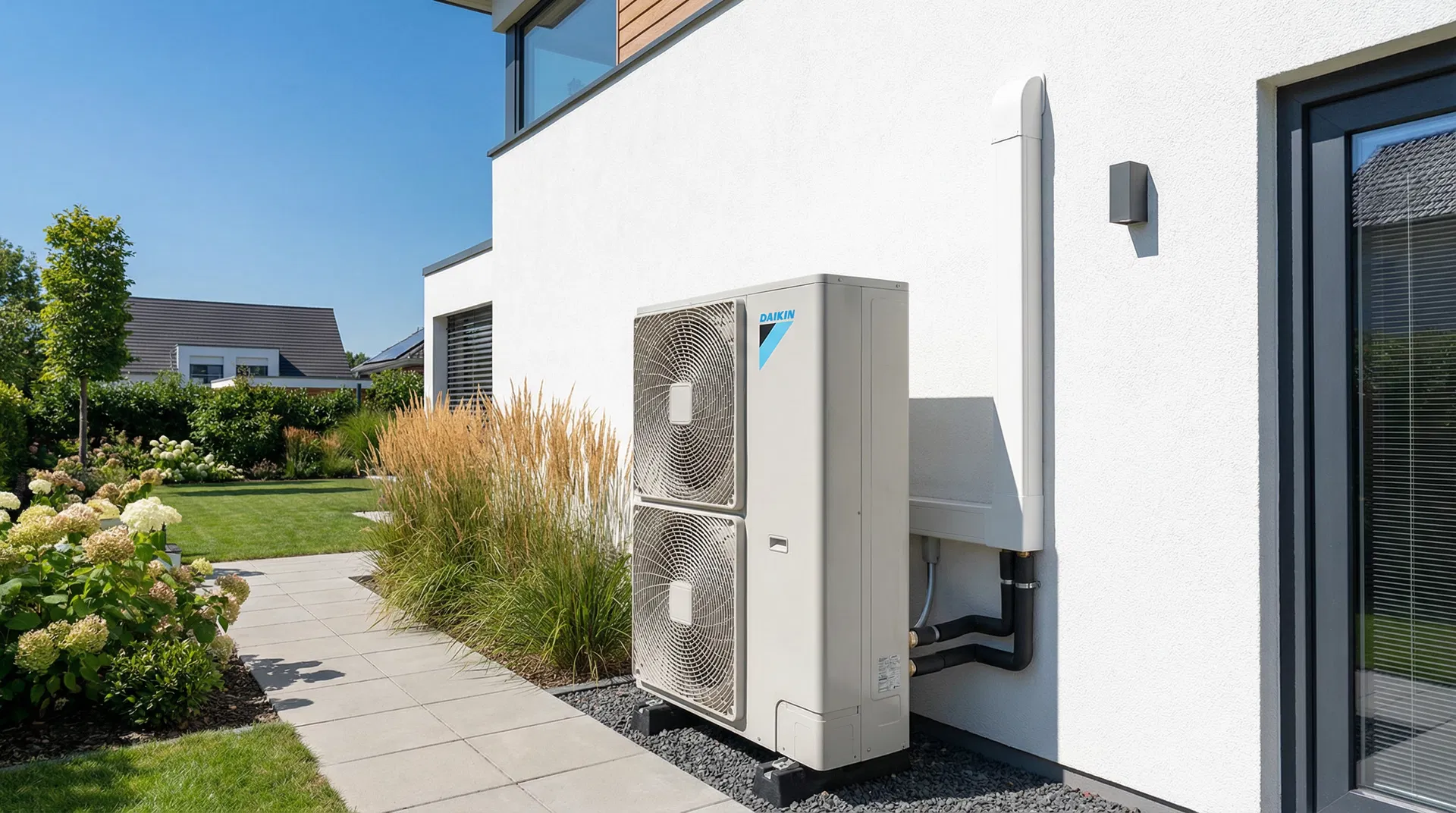
Air source heat pumps (ASHPs) extract heat from the outside air and are by far the most common choice for UK homes. They require an external unit — roughly the size of an air conditioning unit — mounted on an outside wall or in the garden. Ground source heat pumps (GSHPs) extract heat from the ground via a network of pipes buried in your garden. They're more efficient than ASHPs (because ground temperature is more stable than air temperature), but they require significant garden space for the ground loop and are considerably more expensive to install. For most UK homeowners, an air source heat pump is the practical choice.
This is the most important question, and the one that's often glossed over in the rush to promote heat pumps. The truth is that heat pumps work best in well-insulated homes. Because they operate at lower flow temperatures than gas boilers (typically 35–45°C rather than 65–75°C), they need to run for longer periods to achieve the same level of warmth. In a poorly insulated home, this can mean the system struggles to keep up — and your electricity bills will reflect that.
Before installing a heat pump, it's worth assessing your home's insulation — particularly the loft, walls, and floors — and ensuring your radiators are adequately sized. Larger radiators (or underfloor heating) work particularly well with heat pumps because they can deliver heat effectively at lower flow temperatures. A good installer will carry out a full heat loss calculation before recommending a system.
The UK Government's Boiler Upgrade Scheme (BUS) offers grants of £7,500 towards the cost of installing an air source or ground source heat pump. The grant is applied directly by the installer — you don't need to apply yourself — and there's no means-testing, so it's available to all eligible homeowners. To qualify, your property must have a valid EPC (Energy Performance Certificate) with no outstanding recommendations for loft or cavity wall insulation. The scheme is available in England and Wales and is currently funded through to 2028.
The £7,500 Boiler Upgrade Scheme grant is applied at the point of installation — you don't pay it upfront and claim it back. Your installer handles the paperwork. At Prime Degrees, we manage the entire process for you.
A typical air source heat pump installation takes two to three days. The external unit is positioned outside the property (planning permission is generally not required for most domestic installations under permitted development rules), and the indoor unit — which replaces your boiler — is connected to your existing heating circuit. Your hot water cylinder will also need to be replaced or upgraded to a larger, well-insulated model. The installer will commission the system, balance the radiators, and set up the controls before handing over.
This is where it gets nuanced. Heat pumps run on electricity, which is currently around three to four times more expensive per unit than gas. However, because heat pumps are three to four times more efficient than a gas boiler, the running costs can be broadly comparable — and as the electricity grid decarbonises and the price differential narrows, heat pumps will become increasingly cost-effective. The key variable is your home's insulation and the efficiency of the system design. A well-designed heat pump installation in a well-insulated home can genuinely reduce your heating bills; a poorly designed one in a draughty house will not.
Heat pumps are the future of home heating in the UK — but they're not the right choice for every home right now. If your home is well-insulated, you have suitable outdoor space, and you're replacing an ageing boiler, a heat pump with the BUS grant is an excellent investment. If your home needs significant insulation upgrades first, it may be worth addressing those before making the switch.
At Prime Degrees, we're MCS-certified heat pump installers. We'll carry out a full assessment of your home and give you an honest recommendation — whether that's a heat pump, a new gas boiler, or a phased approach that gets you there over time.
Prime Degrees Ltd
Gas Safe Registered Engineers · Hertfordshire & Essex
Our Service
Interested in a heat pump? Find out more about our installation service, the £7,500 Boiler Upgrade Scheme grant, and how to get a free property survey.
Boilers31 May 2026 · 5 min read
 Bathrooms
 Maintenance
Get honest, no-obligation advice from our Gas Safe registered engineers.